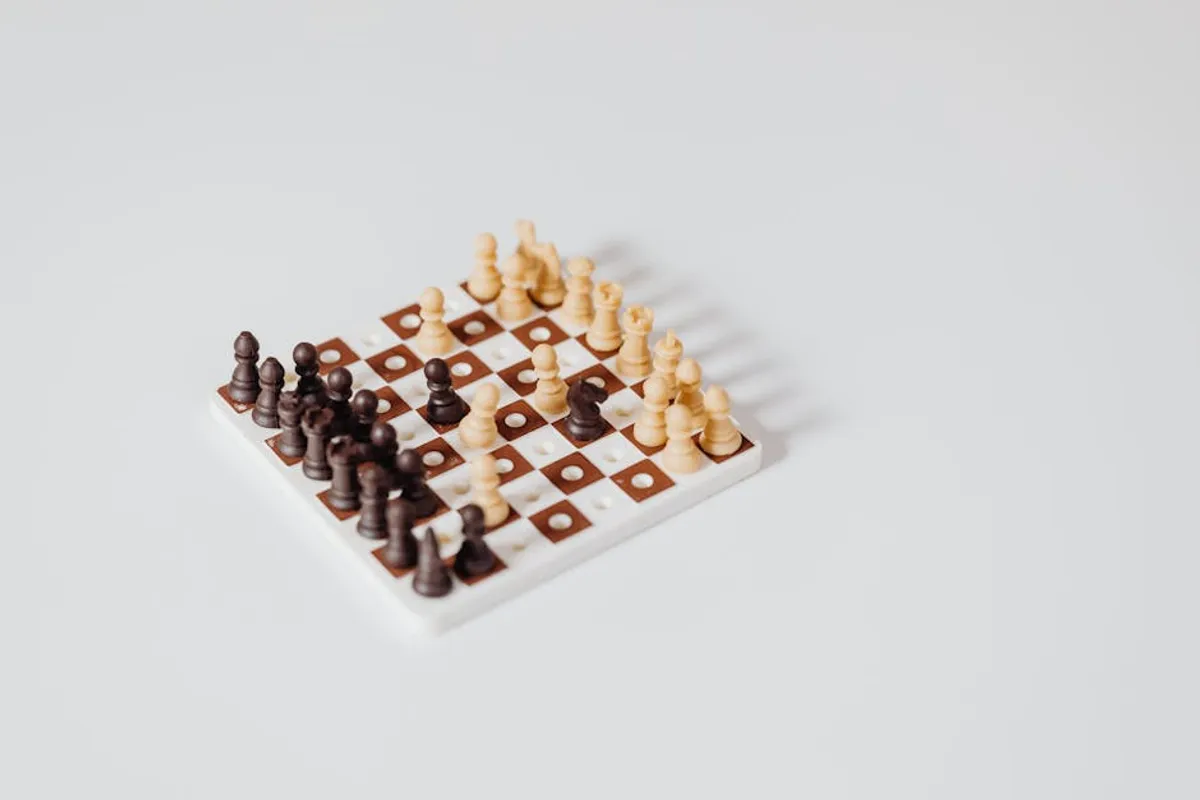
Accurate chessboard setup forms the critical foundation for any game, whether casual or competitive. Errors in initial piece placement or board orientation can lead to immediate disadvantages, confusion, or even invalidate a match before the first move is made. For players seeking consistent performance and adherence to established rules, understanding and avoiding common setup mistakes is paramount. This guide outlines the precise requirements for a standard chessboard arrangement, detailing the specific pitfalls to circumvent, ensuring every game begins on an equitable and correct footing.
Incorrect Board Orientation: The 'White on Right' Rule
One of the most frequent setup errors involves the orientation of the board itself. The standard rule dictates that the square in the bottom-right corner, from each player's perspective, must be a white square. This is often referred to as the 'white on right' principle. Failure to observe this rule means the entire board is rotated 90 degrees from its correct alignment, fundamentally altering the coordinate system and the intended movement paths of pieces.
Impact of error: An incorrectly oriented board causes all piece placements to be effectively shifted, leading to misidentification of squares and potential illegal moves. For instance, a king and queen might appear to be on their correct squares relative to each other, but their absolute positions on the board's coordinate system would be wrong, affecting castling rights and general strategy.
King and Queen Placement: Color Coordination is Key
After correct board orientation, the placement of the king and queen is the next crucial step, and it is a common source of error. The rule is straightforward: the queen always sits on a square of her own color. Therefore, the white queen starts on the white d1 square, and the black queen starts on the black d8 square. Consequently, the king occupies the remaining central square on the back rank, which is e1 for white and e8 for black.
- White Queen: d1 (white square)
- Black Queen: d8 (black square)
- White King: e1 (black square)
- Black King: e8 (white square)
Impact of error: Swapping the king and queen leads to significant strategic disruption. The queen, being the most powerful piece, is usually positioned to exert immediate influence over the center. Misplacing her can weaken the king's safety, alter opening theory, and create an unfamiliar board state that can confuse even experienced players.
Misplacing Knights and Bishops: The Inner Guard
The pieces flanking the king and queen on the back rank are the bishops, followed by the knights. A common mistake is to swap these two pairs, placing bishops directly next to the rooks or knights next to the king/queen. The correct arrangement places the knights on b1/g1 for white and b8/g8 for black, and the bishops on c1/f1 for white and c8/f8 for black.
Correct order from the corner (rook) inwards: Rook, Knight, Bishop, Queen, King, Bishop, Knight, Rook.
Impact of error: Knights and bishops have distinct movement patterns and opening roles. Misplacing them disrupts planned opening sequences, affects piece development, and can lead to a cramped or inefficient early game. Knights are often used for early central control and specific tactical maneuvers, while bishops control long diagonals. Swapping them undermines these inherent strengths.
Pawn Formation: The Front Line
The pawns occupy the second rank for white (a2 through h2) and the seventh rank for black (a7 through h7). Each player begins with eight pawns, forming a complete protective line in front of their major and minor pieces. A mistake here might involve placing fewer than eight pawns, or placing them on an incorrect rank.
Impact of error: Pawns are the fundamental building blocks of a chess position, controlling central squares, creating pawn structures, and serving as defensive screens. Missing pawns or pawns on the wrong rank can severely weaken the player's position, open lines prematurely, or grant an unfair material advantage to the opponent from the outset.
Pro Tip: Before making the first move, always perform a quick visual check of the entire board. Confirm the 'white on right' rule, verify queen color alignment, and scan both back ranks for correct piece order. This habit prevents game-altering errors and ensures fair play.
Ensuring Foundational Accuracy
Mastering chessboard setup is not merely about memorization; it's about establishing a consistent, accurate foundation for every game. Each piece has a specific starting square for strategic and historical reasons. Deviating from these established norms introduces variables that can undermine strategic planning, confuse players, and compromise the integrity of the game.
For those involved in competitive play or serious study, the precision of the initial setup is non-negotiable. It ensures that opening theory remains applicable, tactical patterns are recognizable, and the game unfolds according to its intended structure. Eliminating setup errors allows players to focus entirely on the strategic and tactical challenges of the game itself, rather than correcting fundamental oversights.
Frequently Asked Questions
Why is the 'white on right' rule so important?
The 'white on right' rule ensures a consistent coordinate system for the board. Without it, squares like a1 or h8 would shift, making it impossible to accurately record moves, study openings, or discuss positions universally. It standardizes the playing field for all participants.
What happens if a game starts with an incorrect setup?
If an incorrect setup is discovered before a significant number of moves have been made (often within the first few moves, depending on tournament rules), the game is typically reset to the correct initial position. If discovered much later, the game might be declared void, or specific rules may apply regarding the legality of the game state, potentially leading to a forfeit.
Are there variations to the standard chessboard setup?
While the standard setup is universal for classical chess, variants like Chess960 (Fischer Random Chess) feature randomized starting positions for the back-rank pieces (excluding pawns). However, even in Chess960, specific rules govern the randomization to ensure castling is possible, and the 'white on right' board orientation still applies.